Historical Existence of Asthma: asthma has been known to exist for centuries
Derivation of the Term Asthma: the word asthma is derived from the Greek word for panting (lachániasma)
Definitions of Asthma
National Asthma Education and Prevention Program (NAEPP) (2007) [LINK]
Asthma is a Common Chronic Airway Disorder Which is Complex and Characterized by Variable and Recurring Symptoms, Airflow Obstruction, Bronchial Hyperresponsiveness, and Underlying Inflammation* The Interaction of These Features of Asthma Determines the Clinical Manifestations and Severity of Asthma and the Response to Treatment
Asthma is a Heterogeneous Disease, Usually Characterized by Chronic Airway Inflammation
Defined by the History of Respiratory Symptoms Such as Wheezing, Dyspnea, Chest Tightness, and Cough Which Vary Over Time and in Intensity, Together with Variable Expiratory Airflow Limitation
Other Definitions
Asthma is a Chronic Inflammatory Airway Disorder (Involving Mast Cells, Eosinophils, T-Lymphocytes, Macrophages, Neutrophils, and Epithelial Cells)
Asthma is Generally Characterized by the Presence of Reversible Airway Obstruction (Either Spontaneously or in Response to Treatment) and Bronchial Hyperresponsiveness (to Various Stimuli)
Bronchial Hyperresponsiveness is Defined as an Increase in Airway Resistance in Response to the Inhalation of Physical or Chemical Irritants
However, the Above Features are Neither Sensitive Nor Specific for the Diagnosis of Asthma
Bronchial Hyperresponsiveness Can Be Observed in Allergic Rhinitis without Asthma
Some Patients with Recurrent Wheezing/Dyspnea Associated with Reversible Airway Obstruction/Bronchial Hyperresponsiveness Do Not Have Eosinophilic Bronchial Inflammation
Thickening of Airway Lamina Reticularis (Immediately Under the Supepithelial Basement Membrane) is a More Consistent Feature in Asthma than Eosinophilic Airway Inflammation
This Thickening Reflects the Presence of Airway Remodeling
Some Patients Have Eosinophilic Bronchial Inflammation and Chronic Cough Respond to Inhaled Steroids, But Do Not Have Reversible Airway Obstruction/Bronchial Hyperresponsiveness
Some Patients with Severe Asthma have Neutrophil-Predominant (Rather than Eosinophil-Predominant) Airway Inflammation
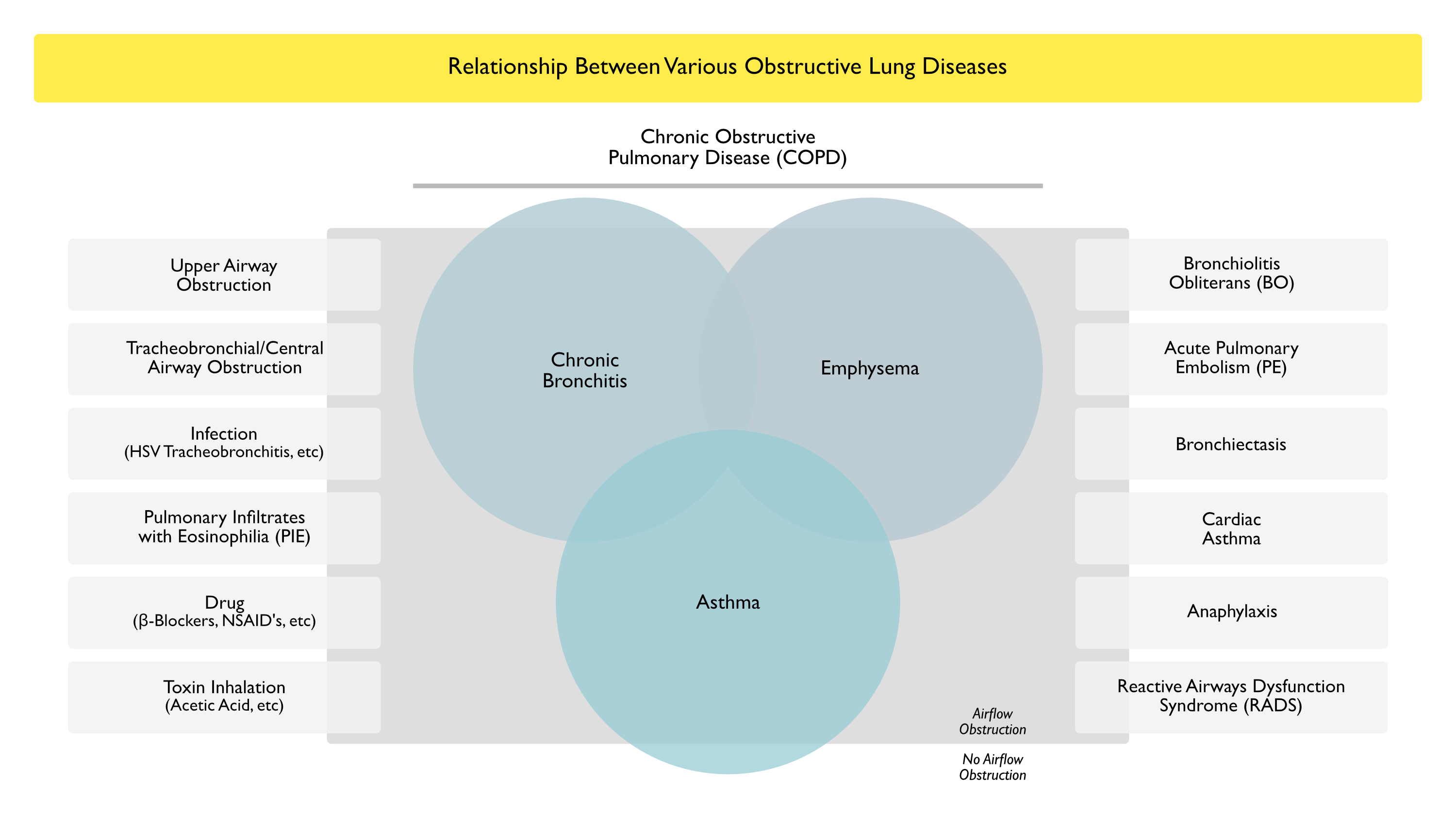
Relationship Between Obstructive Airway Diseases
Epidemiology
Prevalence
International
Approximately 260 Million People Have Asthma Globally (Lancet Respir Med, 2025) [MEDLINE]
Asthma Prevalence Varies Among Countries
At Least Some of the Inter-Country Variability is Attributable to the Use of Different Definitions and Diagnostic Methods
Genetics and Variation in Environmental Exposures (Poor Air Quality) Also Contribute to Inter-Country Variability
United States
From 2021 National Health Interview Survey Data, Approximately 25 Million People Have Asthma in the United States (Approximately 7.7% of the Population) [LINK]
This Has Increased from 7.3% in 2001
Relationship to Race
Asthma Prevalence Rate is Higher (10.7%) in Blacks, as Compared to Whites (8.0%)
Relationship to Household Income
Asthma Prevalence Varies Inversely with Household Income
Patients with the Lowest Annual Household Income Have Asthma Prevalence Rate of 10.4%
Relationship to Other Factors
Asthma Prevalence Rate Increases as Communities Adopt Western Lifestyles and Become Urbanized
However, This Observation Does Not Fully Explain the International Patterns of Asthma Prevalence
The Increase in Asthma Prevalence Has Been Associated with an Increase in Atopic Sensitization and is Paralleled by Similar Increases in Other Allergic Diseases (Such as Eczema and Allergic Rhinitis)
Mortality
International
Globally, Asthma Accounts for Approximately 420,000 Deaths Per Year [LINK]
United States
In the United States, Annual Asthma Mortality Increased from 1982 to 2001, But Has Since Decreased (Similar to International Data) (MMWR Surveill Summ, 2007) [MEDLINE]